Full-Duplex Conversational Audio Datasets for Voice Agents
A full-duplex voice agent has to decide, mid-sentence, whether a sound from the caller means “keep going” or “stop.” Learning that takes conversational audio with each speaker on a separate, synchronized track, scenarios designed to produce backchannels, interruptions and corrections, and transcripts checked by people so short sounds and their timing survive. Abaka records this data with a trained host in every session and delivers 48 kHz per-speaker tracks, timestamped transcripts and speaker metadata.
Full-Duplex Conversational Audio Datasets: Training AI for Natural, Real-Time Dialogue
A customer calls to reschedule a delivery. The voice agent on the line walks through the options: "We can bring it Thursday morning, or Friday between two and five…"
As the agent mentions Thursday, the customer says "mm-hmm." A few seconds later, just as the agent starts offering Friday, the customer cuts in: "Wait, Friday won't work."
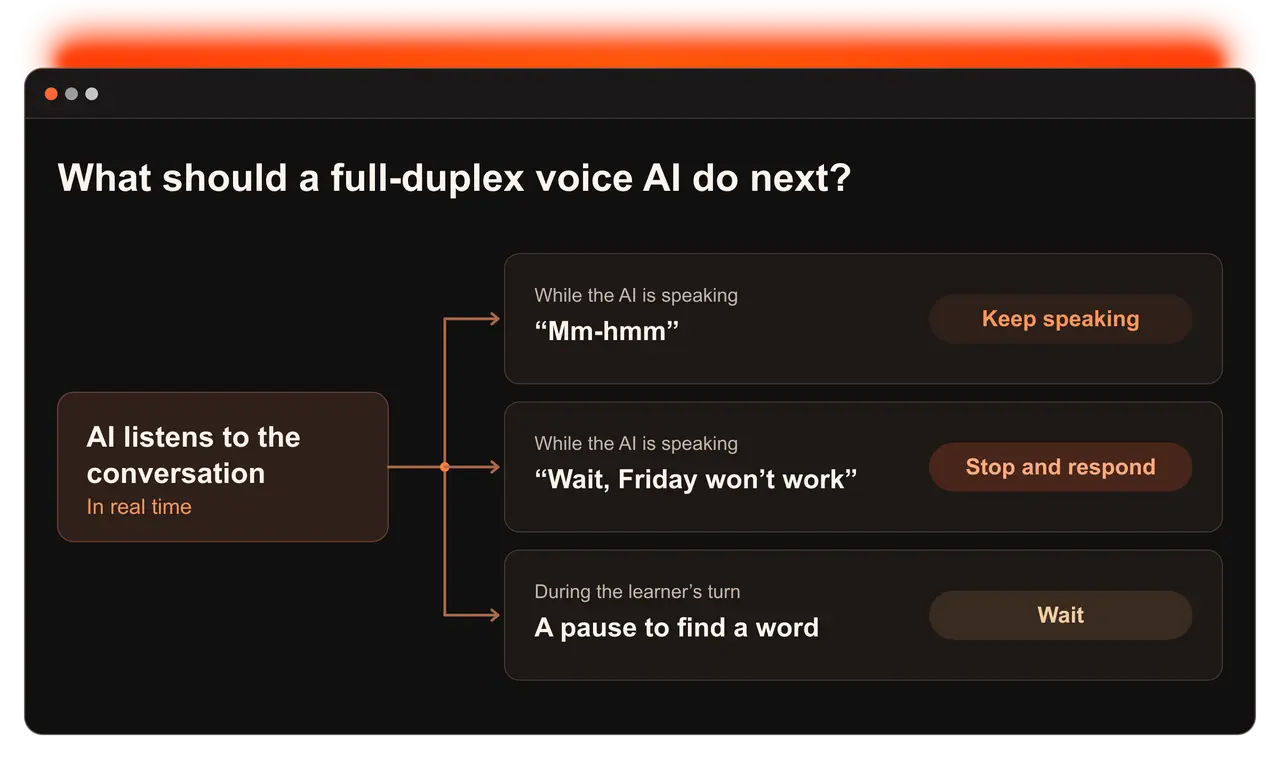
Both times, the customer spoke while the agent was still talking. But the two moments call for opposite responses. The first means I'm following, keep going. The second means stop, something you just said doesn't work for me.
Get the first one wrong, and the agent halts every time the caller makes a small sound. The conversation turns stop-start, and the agent feels clumsy. Get the second one wrong, and the agent talks straight past the objection, confirms Friday, and books a delivery the customer can't receive.
One mistake hurts the experience. The other means the job doesn't get done. As voice agents take on real work, such as changing orders, adjusting plans, and coaching learners, a missed correction changes what happens next. Both mistakes come down to one question: how does a system that is still mid-sentence tell these two moments apart?
Why "Mm-hmm" and "Wait" Are Hard to Tell Apart
Turn-based assistants typically wait for a turn to end before replying. Some add barge-in: if they detect speech while talking, they stop. That handles "wait," but a brief "mm-hmm" may cut the answer off too, and depending on the setup, so can a cough or a TV in the background.
A full-duplex voice system works differently: it can process incoming speech while it is speaking. That makes natural conversation possible, but the system still has to learn what to do with what it hears. Moment by moment, it has to decide whether to keep speaking, stop and respond, or wait.
Those decisions depend on context. Short listener responses like "mm-hmm" or "yeah" are called backchannels and usually mean "go on," but a quiet "yeah" can also begin an objection.
Tone and loudness are clues; what was said, and when, matter just as much. Timing is a big part of that context, so it's one of the things training and evaluation data need to preserve.
Replaying the Call on Two Tracks
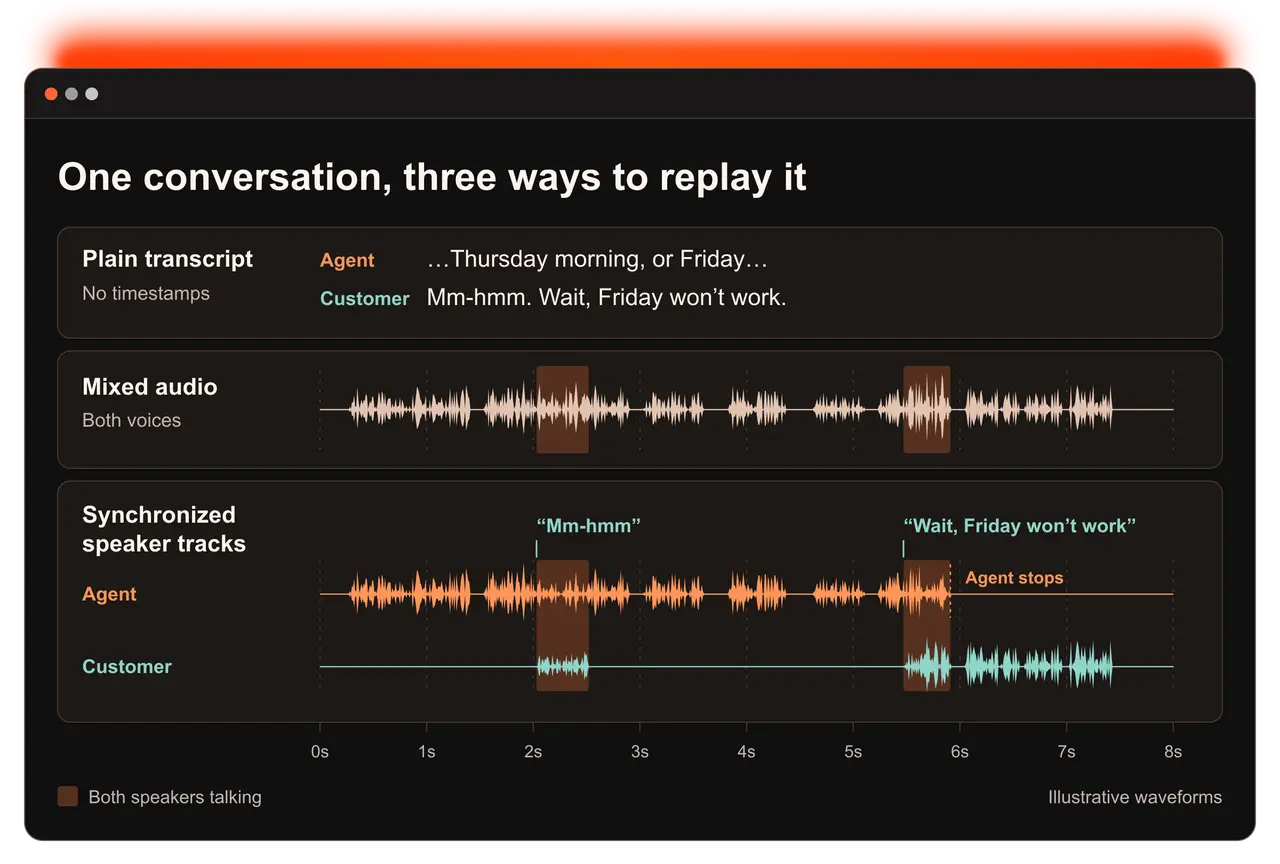
Go back to those few seconds of the call and look at them three ways.
A plain transcript keeps the words but loses the timing, and short sounds like "mm-hmm" are easy to drop.
A mixed recording keeps the timing, but with both voices on one track, it's hard to tell exactly who started when.
Separate, synchronized tracks make both clear: the acknowledgment sits inside the agent's sentence, the objection starts as the agent offers Friday, and the agent's track stops soon after.
Try the same comparison with a real conversation in Abaka's interactive preview. Play the mix, then listen to each speaker separately.
Two-track audio is a property of data, not a capability of the system: it preserves the timing a system needs to learn from and be tested on. You can also split mixed recordings such as podcasts into two tracks, but overlapping speech, the part that matters most here, is the hardest to separate cleanly. Recording each speaker on their own channel from the start avoids that problem.
The opening call is between a customer and an AI agent, but recordings like these capture two people talking. That's the point: they show how people naturally handle interruptions, acknowledgments, pauses, and corrections. They can be used in two main ways. In role-based scenarios, one participant plays the agent, giving a system real examples to learn from. The other participant's track can serve as realistic test input, as in the HumDial benchmark. Either way, the recordings are raw material: how they become training or evaluation examples depends on the task.
Turning a Model Problem into a Data Spec
For most voice agents, turning the behaviors you want into data requirements comes down to three goals.
Telling "I'm listening" from "stop." The system needs many examples of both, in context: backchannels that arrive mid-sentence, and real interruptions that start just as softly. If a dataset has plenty of one and few of the other, the distinction is harder to train and to evaluate.
Knowing when to speak and when to wait. A speaker searching for a word, a sentence trailing off, and a finished turn can all look like silence. The data needs all three.
Getting the task right after an interruption. This is where timing meets outcomes. When the customer objects, the agent has to stop, take in the new constraint, and carry it through the rest of the call. Conversational audio shows how that handoff actually unfolds: when the correction arrived, what it cut into, and how the conversation recovered. It's still a hard problem. On Full-Duplex-Bench v2, which includes a correction task, the full-duplex systems tested often got confused when people talked at the same time. That's why data covering these moments matters for both training and evaluation.
Scenarios shape which moments you get
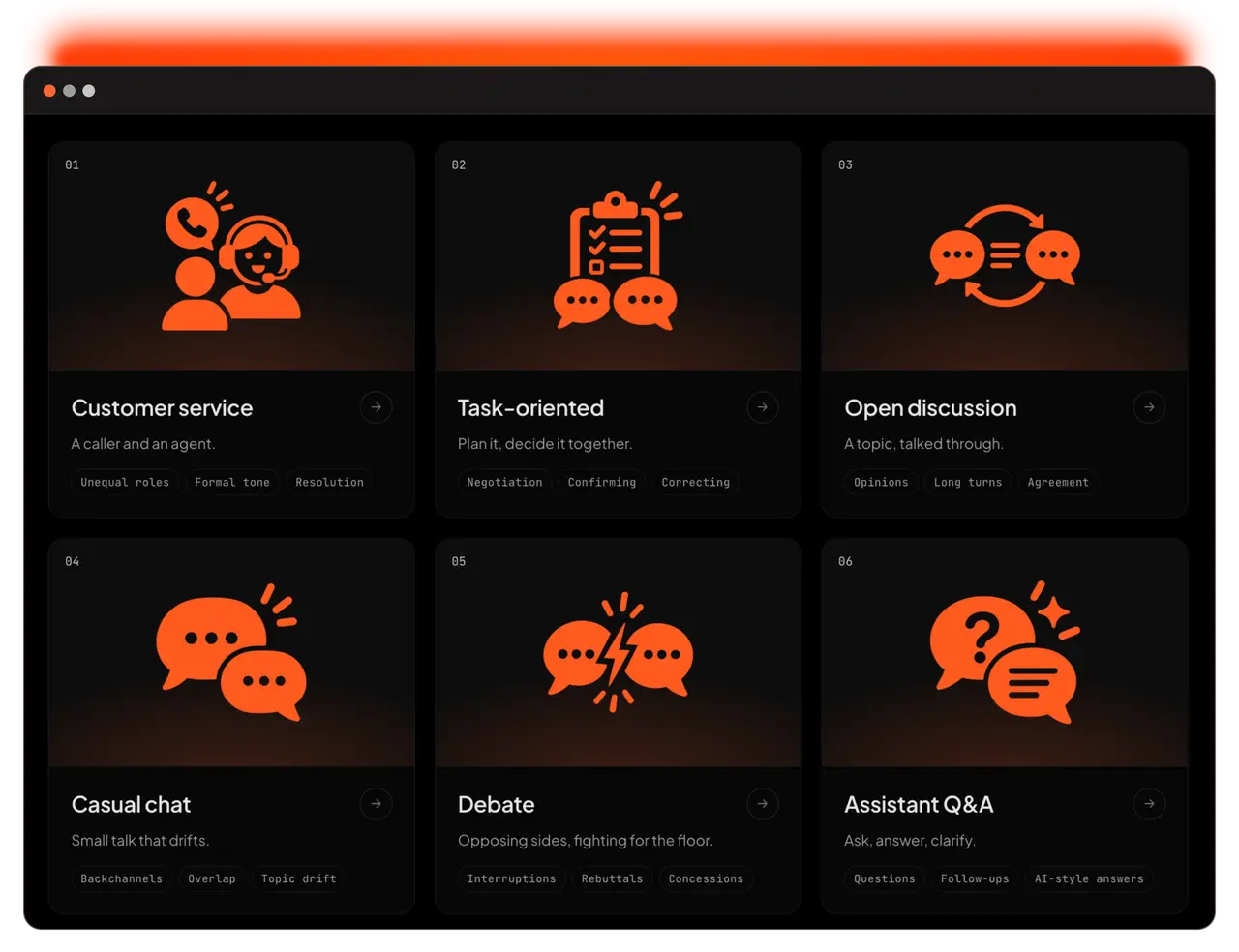
Scenario design can make certain interactions more likely.
Conversation type
What it tends to produce
Customer service / call center
Unequal roles, corrections, barge-ins
Assistant-style Q&A
Follow-ups, clarifications, a clear user and agent
Task-oriented dialogue
Negotiation, changing constraints, decisions
Debate
Interruptions, competing for the floor, rebuttals
Open discussion and casual conversation
Backchannels, pauses, topic drift
The moments you need most are also uncommon, since much of a natural conversation is clean turn-taking. Speaking While Listening, a survey and audit of full-duplex systems presented at EMNLP 2026, argues that many systems could in principle operate full-duplex, but their observed behavior is limited by the interaction patterns in their training and evaluation data. Collection design changes the mix. Asymmetric information, conflicting goals, or tasks that require a correction tend to make the moments you need happen more often, without anyone reading from a script.
A practical way to decide: start with samples. Check whether your target behavior appears, can be located precisely, and has enough context around it. Common backchannels and pauses can often be checked on existing samples. If you need a particular kind of user correcting a constraint mid-task, that's a clear case for custom collection.
What Human Annotation Adds
Automatic transcription is a practical starting point, but short sounds, fillers, and overlapping stretches are easy for it to miss or misplace, and those are among the moments full-duplex systems need to handle. Here is a hypothetical automatic draft and a human revision, both made from the same two speaker tracks:
Code
Automatic draft
Agent     [00:00.3 – 00:05.9]  We can bring it Thursday morning, or Friday between
Customer  [00:05.8 – 00:07.4]  Friday won't work

Human-reviewed
Agent     [00:00.3 – 00:05.9]  We can bring it Thursday morning, or Friday between—
Customer  [00:02.0 – 00:02.5]  mm-hmm
Customer  [00:05.5 – 00:07.4]  Wait, uh, Friday won't work.
The draft missed the acknowledgment and dropped the opening words of the objection. Human annotation fixes that. Annotators proofread the transcript against the audio word for word: restoring missing words, keeping fillers like "uh," repetitions, and self-corrections, and cleaning out ASR errors. They can also label events with start and end times, including overlaps, backchannels, pauses, laughter, breaths, coughs, and background noise. For projects that need precise timing, segment and event timestamps can be refined by hand. How much annotation a project needs depends on what the data will train or evaluate.
How Abaka Builds a Full-Duplex Dataset
Abaka's full-duplex collection starts from the problem you're solving. We work with your team to choose the conversation types, roles, and tasks that produce the events your system needs, and to set speaker requirements such as accent, native language, age, and gender.
Participants are real people talking naturally within the scenario, not reading lines. During recruiting, we test each speaker's device, connection bandwidth, and background noise, then screen and grade speakers accordingly. Each speaker is recorded on an isolated track on a shared timeline, so overlap is preserved as recorded rather than reconstructed. A trained host listens live during every session and can deal with problems such as echo, background noise, or uneven volume while recording, including re-recording when needed. Every session then goes through a QC review before delivery.
Our standard two-speaker English delivery includes synchronized 48 kHz, 16-bit PCM WAV tracks for each speaker, timestamped transcripts, and speaker metadata. Human annotation is optional, from verbatim proofreading to event labels and hand-refined timestamps. Every participant signs an agreement consenting to the use of their voice recordings for AI model training within the agreed scope.
Start with One Moment
Think back to that delivery call. You don't need a complete data spec to start, just one moment from your own product you want handled better: an agent that stops for every "mm-hmm," talks over corrections, or loses the thread after an interruption.
There are two easy ways to start:
Listen to the two-track samples. Solo each speaker and check whether your target moments show up, can be located precisely, and come with enough context.
Talk to our team. If the moments you need aren't in the samples, tell us what you're building.